Hidden Dangers of Bigger, Heavier Light Trucks: Why Safety Must Come First
Road to Zero Coalition report shows SUVs, vans and pickup trucks are particularly dangerous compared to smaller cars.


Road to Zero Coalition report shows SUVs, vans and pickup trucks are particularly dangerous compared to smaller cars.
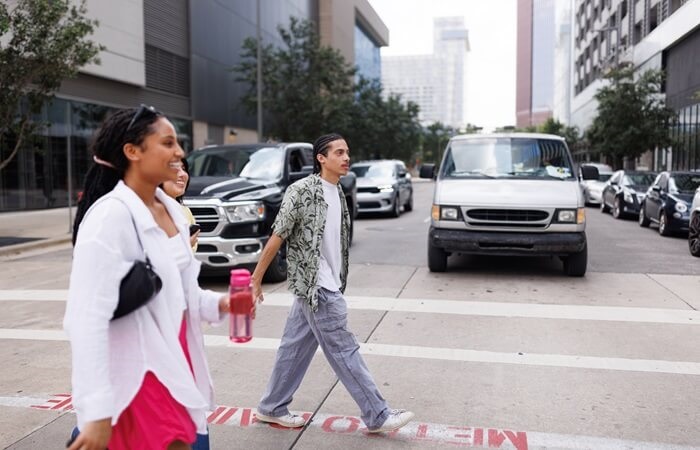
In just a few decades, the types of vehicles most commonly seen on U.S. roads have completely changed. The sedan that once ruled the highways has been overshadowed by the rise of SUVs, pickup trucks and vans — collectively known as "light trucks." Today, these vehicles not only make up approximately 75% of new vehicle sales, but their average weight and footprint are at record highs. What does this shift to bigger, heavier passenger vehicles mean for safety on our roads?
Recently, the Road to Zero Coalition, a National Safety Council initiative funded by the National Highway Traffic Safety Administration with a goal of zero roadway deaths by 2050, released a new report, Massive Hazards: How Bigger, Heavier Light Trucks Endanger Lives on American Roads. This paper collects years of academic and professional research to explain how the increasing dominance of light trucks poses significant dangers not only to pedestrians and cyclists but also to other drivers. As consumers flock toward bigger vehicles under the assumption that "bigger is safer" for themselves, the truth is larger vehicles often threaten lives in ways smaller cars do not.
The statistics are alarming. In 2022, pedestrian fatalities in the U.S. reached their highest levels in over four decades. Similarly, bicycle fatalities have also surged, with 2022 being the deadliest year for cyclists in the history of NHTSA’s statistics. While the proportion of all roadway fatalities that are vehicle occupants steadily decreases, vulnerable road users make up a larger proportion of people dying on American roadways. Could the increasing market share of light trucks be one of the reasons? With pedestrians being 50% more likely to die when struck by an SUV or pickup truck than when hit by a smaller car, this topic cannot be ignored by anyone dedicated to ending road deaths. This report outlines the factors we believe contribute to the worsening danger:
The design of these larger vehicles: The high, flat front ends of SUVs and pickups increase the risk of severe injuries or death when colliding with pedestrians or cyclists. Unlike smaller cars with lower profiles and sloped hoods, light trucks tend to push pedestrians down to the ground or under the vehicle rather than over it.
The visibility problem: Blind zones, particularly in front of large vehicles, make it easier for drivers to miss seeing or reacting to pedestrians in particular. In fact, studies have shown that the front blind zone of a typical full-sized truck can be up to 11 feet longer than that of a sedan, which can cause smaller pedestrians – such as entire groups of young children – to effectively vanish from the driver’s view, with potentially tragic consequences. Despite backup cameras being mandated in newer vehicles, no requirements exist for forward visibility, which could help prevent these crashes.
Front Blind Zone
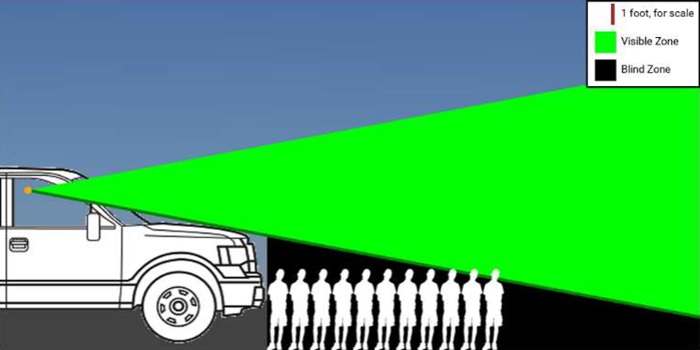
Front blind zone extends out by 11 preschool children (8 feet 3 inches).
Credit: USDOT Volpe Center
An “Arms Race” on the Road: The rise of light trucks also presents a dilemma for drivers. As more people purchase bigger vehicles, there is a perceived need for everyone else to follow suit with their own safety in mind, leading to what some safety experts call an "arms race." Smaller cars are increasingly at a disadvantage in collisions, as crashes between a sedan and a pickup truck often result in much more severe injury to the smaller vehicle’s occupants – a factor called crash incompatibility. This creates a cycle where drivers feel compelled to buy larger vehicles for their own protection, further exacerbating the safety risks to others on the road.
Speed and size are a deadly combination: One often-overlooked factor is how the size of these vehicles compounds the impact of speed and acceleration in a crash. Research shows that drivers of taller vehicles like SUVs and trucks tend to underestimate their speed, often driving faster than they realize. For pedestrians or cyclists, even a few extra miles per hour in impact speed can be the difference between life and death.
The Road to Zero Coalition’s report offers several actionable recommendations to curb the dangers posed by light trucks. These include:
1. Redesigning vehicles for better visibility: Narrowing the A-pillars and reducing hood height would greatly improve drivers' ability to see pedestrians and cyclists, especially in critical zones around intersections.
2. Stronger safety standards: Current crash-testing standards focus primarily on the safety of vehicle occupants, not those outside the vehicle. New regulations should address pedestrian safety features and make them mandatory, particularly for larger vehicles.
3. Encouraging safer streets and disincentivizing large vehicle purchases: Local governments can reduce the risks by adopting traffic-calming measures like lower speed limits, better street lighting, and the installation of pedestrian islands and protected bike lanes to protect vulnerable road users. Higher registration or parking fees for larger vehicles can also be implemented at the local level, as seen in some American and Canadian cities.
4. Technological solutions: Intelligent Speed Assistance and other advanced driver assistance system (ADAS) safety technologies could reduce the potential for human error leading to a crash, but these are not yet widely available as standard in new vehicle purchases.
5. Reforming outdated policies that led to the “arms race”: A variety of tax policies plus unequal emissions standards dating from as far back as the 1960s and 1970s incentivized the manufacturing of SUVs, vans and light trucks over smaller passenger cars in the first place. As the drivers who came of age during the oil crisis reach their well-deserved retirement, so should these policies from an era when the American vehicle landscape looked much different.
As consumers, we often assume that bigger vehicles mean safer driving. However, the reality is that while light trucks may offer better protection for their occupants, they often do so at the expense of others on the road. If we want to reduce fatalities and create safer roads for all, vehicle design must evolve, and safety standards must be updated. It’s time to put safety first, both for those inside and outside the vehicle, and it will take the government, manufacturers and drivers all coming together to tackle this. That way, more people can return home safely each day.
To learn more about the Road to Zero Coalition and help us achieve our goal of zero roadway deaths by 2050, visit nsc.org/roadtozero.

With a century-long legacy, the National Safety Council is a global center for safety expertise. Let's work together to align resources. We look forward to learning about ways we can join efforts to expand safety everywhere!
There are no items in your cart