
0
0
- NSC.org
- NSC Shop
- Injury Facts
- Safety+Health Magazine
 Julia Kite-Laidlaw, Senior Program Manager, Road to Zero
Last week we gathered in Washington, and hundreds of you joined online, to reflect upon and celebrate 10 years of Road to Zero. Firsthand, I saw that the strength of our coalition is in the dedication and expertise of its members. You are addressing traffic safety challenges from so many different angles, each of them crucial in sustaining our momentum. I was proud to share with you the work of our Road to Zero grant recipients, who are leading the way towards a safer future with innovative research, training and practice.
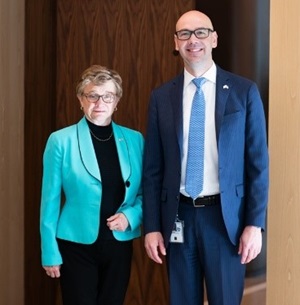 NSC CEO Lorraine Martin and NHTSA Administrator Jonathan Morrison
My sincere thanks go to our hosts, the National League of Cities; to our keynote speaker Jonathan Morrison, administrator of NHTSA; and to all the panelists who took time to share insights from their important and fascinating work. To all our members – thank you for your ongoing partnership and support
Best,
Julia Kite-Laidlaw
On Thursday, May 21, both the House Committee on Transportation and Infrastructure and the House Committee on Energy and Commerce held legislative markup hearings to advance bills that encompass a surface transportation reauthorization legislative package. The Building Unrivaled Infrastructure and Long-Term Development (BUILD) for America’s 250th Act and the Motor Vehicle Modernization Act of 2026 enable key rulemaking authorities, grant programs and research priorities at the U.S. Department of Transportation, including automatic emergency braking (AEB) for vulnerable road users, the Safe Streets and Roads for All (SS4A) grant program, polysubstance impairment research, and the creation of an inter-agency working group on roadside worker protection
A decade is an eternity in technology. That’s why National Safety Council has updated and re-launched its groundbreaking My Car Does What? website to help drivers discover what all those features in their vehicles can (and cannot) do. With new information about advanced driver assistance systems, including active driving assistance, active parking assistance and lane centering assistance, this is your go-to resource whether you’re buying the newest model or just looking to refresh your knowledge. Check it out and let us know what you think!
Pediatric vehicular heatstroke is tragic, yet 100% preventable. On average, 37 children die each year in the U.S. from hot cars. As temperatures continue to rise this season, remember that heatstroke can occur when outdoor temperatures are as low as 60 degrees.
NHTSA urges all parents and caregivers to follow the critical safety reminder: Stop. Look. Lock.
Help NHTSA amplify this life-saving message. You can find comprehensive Vehicular Heatstroke Prevention campaign materials, including public relations tools and social media resources in English and Spanish, on the Traffic Safety Marketing website.
For more information, visit NHTSA.gov/Heatstroke.
Drivers are more likely to use their phones while speeding, an IIHS analysis of data collected by insurers’ safe-driving apps shows. On highways, the share of driving time spent handling a phone increased 12% for every five miles per hour over the speed limit drivers traveled. Read the full findings here.
Governors Highway Safety Association (GHSA), with support from the National Road Safety Foundation (NRSF) and the SteerSafe Partnership, has produced a comprehensive new guidebook, Intelligent Speed Assistance: A New Tool for Safer Roads. The guidebook comes as numerous states have either enacted laws implementing Intelligent Speed Assistance (ISA) or are considering doing so.
The guidebook details steps and actions for State Highway Safety Offices (SHSOs) to help support and advance the adoption of active ISA. This in-vehicle technology identifies the posted speed limit and ensures the driver does not exceed it. Speeding has historically been difficult to manage through roadway design alone, but ISA provides a proactive, technology-driven intervention that can reduce crash risk and injury severity. While active ISA could benefit all drivers, the guidebook highlights three groups – repeat speeding offenders, fleet drivers and newly licensed teens – who would benefit the most.
With traffic deaths remaining high and police resources increasingly stretched, our new report offers an optimized path forward — right-sizing enforcement as part of a Safe System approach to advance safety in cost-efficient and data-informed ways. You can access the full report here. Long reports not your thing? VZN’s companion brief distills the key takeaways into an accessible format.
Join Together for Safer Roads on June 3, 2026, at 12 p.m. EDT for the next TSR Talk: Intelligent Speed Assistance in Fleet Management. If you are considering intelligent speed assistance (ISA) for your fleet but are unsure where to start, this webinar will walk through real-world best practices for deploying ISA, featuring insights directly from fleet managers who have already implemented the technology. Learn what benefits fleets are seeing, how they approached implementation, and how they built support among drivers and leadership. Register here.
There are no items in your cart